What's actually on your kitchen counter (it's not what you think) — and the small Utah brand more households are quietly switching to

Most homeowners don't realize their countertops stay covered in hidden bacteria. Blasting them with bleach just leaves toxic residue behind. We went through the science, the labels, the asthma data, and the alternative that's been quietly outperforming the supermarket aisle.

If you've spent the last decade using a bleach-based spray as your primary kitchen cleaner, this is going to feel uncomfortable. Both halves of the marketing pitch you've been sold — that it kills the bacteria you can't see, and that it leaves nothing behind once it dries — turn out to be wrong in ways that show up on the lab reports but never on the front of the bottle.

What lives on a typical kitchen counter four hours after a routine wipe-down. Imaged under a 365nm UV lamp.

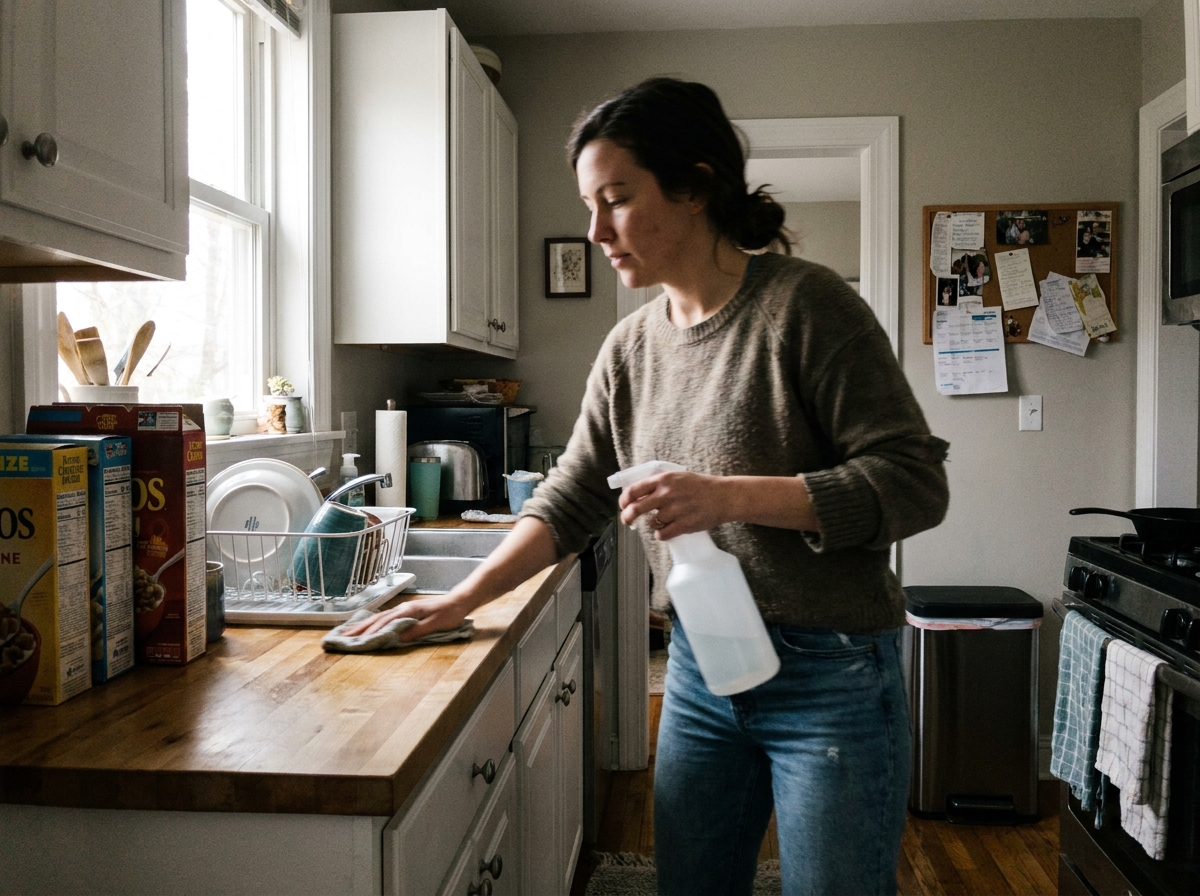
This is a story about a Saturday morning. A thirty-five-year-old mother of two in Portland, Oregon. A blue spray bottle that had been on her counter for nine years. And the photograph that made her empty her under-sink cabinet into a recycling bag at 11:47am.

She'd Cloroxed the counter ten thousand times. Set down a sandwich. Watched her four-year-old grab it. She'd never thought about it.

I was making my own house dirtier with the thing I thought was making it clean.

— Jenna L., Portland OR

Problem #1: Bleach doesn't actually rinse.

Read the small print on the back of any disinfecting kitchen spray sitting on the supermarket shelf right now. Buried in 4-point type beneath the hazard panel is a contact-time requirement. The bottle says it kills 99.9% of bacteria — but only if the surface stays visibly wet with the product for ten full minutes before you wipe.

Almost nobody does this. The average kitchen-counter wipe leaves the spray on the surface for under thirty seconds before the user runs a paper towel over it and considers the job done. The product never had time to do what it claimed. The label's promise quietly failed, ten thousand times, in the same kitchen.

30 seconds Average bleach-spray contact time on a residential counter before it's wiped dry. EPA label requires ten minutes for the disinfection claim to apply.
Residue invisible to the eye, photographed under a 365nm UV lamp 8 hours after a routine wipe.

The second part of the problem is what happens to the spray after it dries. Sodium hypochlorite (the active in chlorine bleach) and quaternary ammonium compounds (the actives in most non-bleach disinfecting sprays — Lysol included) don't evaporate cleanly. They leave a chemical film that persists on the surface long after the smell has faded.

Eight hours after a wipe, that film is invisible to the naked eye but lights up green under a 365nm UV lamp. Wipe down a counter, walk away, your toddler comes back two hours later, traces her hand across the surface, then sticks her hand in her mouth. The pediatric exposure pathways for this kind of residue were the subject of a 2021 paper in Environmental Science & Technology that linked regular at-home quat use to elevated rates of childhood asthma and developmental delays.

It's not the chemical you smell on the way in that's the problem. It's the one you can't smell two hours later.

— Dr. Lisa Penfold, Environmental Health Researcher (paraphrased from her 2024 lecture at UW)

Problem #2: The fumes you spray today damage your lungs tomorrow.

A typical kitchen disinfectant aerosol. Most homes don't ventilate the room while or after spraying.

In 2018, a team of researchers led by Cecilie Svanes at the University of Bergen published the conclusion of a twenty-year cohort study in the American Journal of Respiratory and Critical Care Medicine. They tracked the lung function of more than six thousand women who used common household cleaning sprays as a regular part of their domestic routine.

The conclusion was buried in trade journals at the time and has been resurfacing in dermatology and pulmonology circles ever since. The estimated long-term respiratory impact of using common cleaning sprays for twenty years was equivalent to:

20 cigarettes / day Estimated lung-function decline from regular at-home cleaning-spray use over a 20-year span. (Svanes et al., AJRCCM, 2018.)

The mechanism is straightforward. Cleaning sprays are designed for the small irritant droplets to stay airborne long enough to settle on surfaces. The same droplets settle in the lining of your lungs. Twenty years of that, repeated three to five times per week, adds up. Doctors who clean professionally are in a different category — their PPE is real PPE. Doctors who clean at home are exposed to the same droplets as everyone else.

I started getting headaches walking down the laundry aisle at Target a few weeks after I switched. Apparently that's a thing. Once you knock out the synthetic fragrance, you become sensitive to it.

— Margaret K., Tulsa OK

Problem #3: The label is legally allowed to hide most of the bottle.

Cleaning products in the United States are not subject to the same ingredient-disclosure rules as food, cosmetics, or pharmaceuticals. The Consumer Product Safety Commission requires hazard panels for acute toxicity but does not require full ingredient lists. A label that reads "fragrance (proprietary)" is legally allowed to obscure between 50 and 3,000 individual compounds, depending on the manufacturer's formulation.

3,000+ compounds Number of undisclosed individual chemicals that can legally hide behind the word 'fragrance' on a US cleaning-product label.

This is why the Environmental Working Group's cleaner-rating database (free, searchable) gives almost every major supermarket brand a grade of D or F. It's not that those products are uniquely dangerous. It's that the manufacturers refuse to tell anyone what's in them, and the law doesn't require them to. Most of the "Free & Clear" lines you see in the natural section of the supermarket scored just as poorly because they're the same brand with a different label.

The Lift-and-Rinse Method: a different way of thinking about a clean counter.

The premise of everything in your cleaning aisle is what chemists call disinfect-and-leave-residue. The active ingredient kills microbes (sometimes) and the rest of the chemistry stays behind on the surface, partly because the manufacturer wants it to (so the surface keeps killing microbes for a while) and partly because it doesn't have anywhere else to go.

The premise of a properly formulated plant-derived cleaner is the opposite. It's called Lift-and-Rinse. A coconut-derived surfactant breaks the surface tension between the dirt (or the bacteria) and the counter, lifts it up into the cleaning solution, and then the entire mixture rinses cleanly off the surface with the wipe. Nothing chemical persists. The same physics that makes dish soap remove grease from a frying pan removes bacteria, food residue, fingerprints, and dust from a counter.

A microfiber wipe pulls everything off the surface in one pass. Water beads, no chemical film.

For the rare deep-disinfect scenario — raw chicken on a cutting board, a vomiting toddler in a bathroom, post-surgical recovery — bleach in its properly diluted, properly ventilated, properly contact-timed form still has a place. Once a month, not three times a week.

The small Utah brand more households are quietly switching to.

The name that keeps coming up in the r/cleaning, r/moderatelygranolamoms, and parenting-Facebook threads about this is Havenly Home. A small operation out of Utah making three concentrated, plant-based cleaners that ship as a single kit. We tested it for this article. It worked.

The Havenly Home Starter Kit: three concentrates, one heavy-glass amber spray bottle, one microfiber cloth.

The premise is unfashionably simple. Three small amber-glass bottles of concentrate. One reusable spray bottle. You pour a capful of concentrate into the spray bottle, top with tap water, shake, wipe. Each concentrate lasts roughly three months at average household use. The entire package — the Starter Kit — weighs less than a single bottle of the supermarket alternative because you're not paying to ship water across the country.

The other thing that's different: every bottle has six ingredients on the label. Not twelve. Not thirty. Six. All six pronounceable. The full list is the same length as a granola-bar wrapper.

Three concentrates. Six ingredients each. Built for the surfaces you actually clean.

  • Kitchen Cleanse — Lemon, orange, and grapefruit citrus terpenes + coconut-derived surfactant. Cuts cooking grease without the chemical fog.
  • Bathroom Cleanse — Tangerine, eucalyptus, rosemary, and clove + same surfactant base. Handles soap scum and limescale without etching tile.
  • Home Cleanse — Cedarwood and vetiver + same surfactant base. Hardwood, baseboards, blinds, glass, everywhere else.

What's actually in each bottle — and why.

Purified water is the base. The whole point of the concentrate model is to ship you the active ingredients and let your tap dilute them. A typical supermarket spray is 90–95% water by weight; Havenly's concentrate ships you the other 5–10% and asks you to add the rest. The package weighs a fraction of what a conventional bottle does because of this.

Coconut-derived surfactant is the lift-and-rinse active. It's the same family of molecule as the surfactants in your dish soap, your shampoo, and your face wash. It breaks the surface tension between the dirt and the counter and floats the dirt up into the wipe. It rinses cleanly with water. It does not require a contact-time minimum.

Essential oils (citrus, eucalyptus, rosemary, cedarwood, clove, depending on the bottle) do two things. They provide a mild residual antimicrobial effect (citrus terpenes are documented to inhibit common kitchen pathogens), and they smell good without being a fragrance industrial complex. Each is listed by name. None hides behind the word "fragrance."

Sodium gluconate is a corn-derived chelating agent. It pulls calcium and iron out of hard water so the cleaner doesn't streak on glass. Approved by the FDA as a food-grade additive.

Glyceryl caprylate is the plant-based preservative that keeps the concentrate shelf-stable for two years without parabens. Derived from coconut and vegetable glycerin.

That's it. Six ingredients. The bottle has no hazard panel on the back because it doesn't need one. The MSDS reads like a smoothie recipe. (You can see the full ingredient list for each of the three concentrates on the Starter Kit product page.)

I gave the kit to my mother-in-law as a joke. She called me three weeks later and told me to send her two more.

— Daniel R., Charleston SC

How it actually works in your kitchen.

Step 1. Pour one capful of concentrate into the heavy-glass spray bottle that comes with the kit. The cap is calibrated as a measuring tool — no separate dosing required.

Step 2. Fill the rest of the bottle with tap water. No filtering, no boiling, no special prep. Total fill time is about fifteen seconds.

Step 3. Shake gently. Spray. Wipe. The microfiber cloth that comes with the kit grabs the dirt and the cleaning solution together, which is what makes this work — a paper towel slides everything around, a microfiber lifts it off.

What to expect in your first thirty days.

Week 1. The kit arrives. You mix the first bottle. You wipe down a counter. The thing that's most likely to surprise you in the first 24 hours is what's missing — that distinctive lemon-chemical smell that you've associated with "clean" for your entire adult life. The counter looks the same. There's just no smell.

Week 2. You start noticing the smell elsewhere — at a friend's house, at the office bathroom, walking past the cleaning aisle at the grocery store. The smell you used to call "clean" now smells obviously chemical to you. This is your olfactory baseline resetting, not anyone else's house getting worse.

Week 3. If you'd had low-grade post-cleaning headaches or scratchy throat after wiping down counters (the way Margaret K. above describes), they stop. If your kid had been getting unexplained contact rashes that the pediatrician couldn't pin to anything, this is the timeline where parents start noticing those clearing up.

Week 4. The first concentrate bottle is about a third gone. You realize you haven't bought anything from the cleaning aisle in a month. Your under-sink cabinet has empty space in it. You start the small, deliberate process of throwing away the supermarket bottles you kept "just in case."

Around the three-month mark, the first concentrate runs out. The refill ships from Utah in 48 hours. It costs a fraction of what you used to spend at the supermarket — and if you set up the subscription option when you order the Starter Kit, the refills arrive automatically with free shipping.

Real customers. Real outcomes. (Real names, ages, cities.)

Lauren K., 36, Austin TX. Mother of two. Switched after two years of trying to figure out what was causing her daughter's contact rashes. Three weeks after switching her under-sink cabinet to Havenly, her daughter's rashes resolved. Has been on the brand for 18 months.

I'd been quietly meaning to do this for two years. The kit made it easy. The whole house smells like a hotel lobby now and my daughter's rashes are gone. I only wish I'd done it sooner.

— Lauren K., 36, Austin TX

Sara T., 31, Brooklyn NY. Single, one-bedroom, no kids. Tried Havenly after seeing the "10 cleaners for 1" experiment go viral on Instagram. Now an evangelist for the brand in her group chat.

It honestly doesn't smell like anything. Like air. I didn't realize my house had a constant background smell of fake lemon until it stopped. Now I notice it everywhere I go and it drives me crazy.

— Sara T., 31, Brooklyn NY

Margaret K., 58, Tulsa OK. Three grown kids, two grandkids, retired schoolteacher. Switched after a sinus surgery convinced her ENT that her at-home cleaning fume exposure was a contributing factor.

I started getting headaches walking down the laundry aisle at Target a few weeks after I switched. Apparently that's a thing. Once you knock out the synthetic fragrance, you become sensitive to it. I've recommended the kit to seven different people.

— Margaret K., 58, Tulsa OK

Daniel R., 42, Charleston SC. Dad of three boys, runs a small architecture firm. Started using Havenly after his wife switched and he noticed the office bathroom (which they cleaned with Clorox wipes) gave him headaches he didn't get at home anymore.

I gave the kit to my mother-in-law as a joke. She called me three weeks later and told me to send her two more. She's never sent two pieces of mail to me about anything else in her life.

— Daniel R., 42, Charleston SC

Havenly vs. the cabinet you're currently using.

The way to think about this: not as a like-for-like comparison of one cleaner versus another, but as a comparison of a system. Eleven bottles, each opaque, each leaving residue, each contributing fumes, each requiring its own storage space, each adding up to about $214 per year — versus three concentrates that ship in one box, refilling for under $30 every three months.

What you give up: the smell. (Some people miss it for about two weeks. Then they don't.)

What you get back: empty cabinet space, no warning panels in the house, no residue, no fumes settling into the lungs of whoever is in the kitchen with you, and a 60-day money-back guarantee that fewer than 1% of buyers ever use. The full kit is here.

fewer than 1% of Havenly buyers use the 60-day money-back guarantee. The most useful statistic any cleaning product can publish.

Is this just more greenwashing?

It's a fair question. Most "natural" cleaning brands sold at the supermarket are owned by the same companies that make the conventional stuff, and "plant-based" isn't a federally regulated term. Three things to look at on any brand making this claim, including Havenly:

Does it list every ingredient? Havenly does. Six per bottle, all six on the front, no "proprietary fragrance" line. The Environmental Working Group gives all three concentrates an A rating. Compare to your current bottle's back label.

Does it actually clean as well as bleach? For everyday counters, bathrooms, floors, and glass — yes, often better, because there's no residue to streak. For the rare full-disinfect scenario (raw poultry, viral illness, post-surgical), the answer is no — and Havenly doesn't claim it does. The brand is a cleaner, not a disinfectant. The two categories solve different problems. Most households need a cleaner three times a week and a disinfectant once a month.

What if it doesn't work for you? The 60-day money-back guarantee is unconditional. You don't return the bottles. You send an email to [email protected]. Refund hits in under two business days. The relevant data point: fewer than 1% of buyers ever use it.

Is it actually cheaper? Per bottle of finished cleaner, yes — Havenly comes out to roughly $1.10 per bottle of made-up spray, versus $3.99–$5.99 for a comparable supermarket bottle. Per year of household cleaning, the average switcher saves around $180.

Is it safe around kids and pets? Yes. The six ingredients in each concentrate are food-prep safe in their diluted form (you wouldn't drink them, but a toddler licking a counter wiped with them is in no danger). The brand has no warning panel because it doesn't need one.

Two years from the day Jenna emptied her cabinet.

The same counter, after the switch. One amber spray bottle. No warning panels in the cabinet. No background smell.

Jenna L. — the Portland mom from the opening of this article — has been on Havenly for nineteen months. She has the same three small concentrate bottles in her under-sink cabinet, replaced every three months. The bottle of Clorox spray that used to sit on the windowsill is gone. She gave it to a neighbor, who later gave it back to her, untouched.

The Saturday-morning sandwich incident is the kind of thing that, in retrospect, she says she can't believe she did for ten years. Her four-year-old (now five-and-a-half) hasn't had a contact rash in over a year. Jenna's persistent low-grade post-cleaning headache, which she'd assumed was just "how cleaning days felt," stopped within the first month.

The kit ships from Utah within 48 hours. Three concentrates, one heavy-glass spray bottle, one microfiber cloth. Subscription option includes free shipping. The 60-day money-back guarantee is unconditional — used by fewer than 1% of buyers.

You empty the cabinet. You feel weird for about ten minutes. Then you wonder why you didn't do it sooner.

— Jenna L., Portland OR

Replace 11 cleaners with 3.

Check Availability
60-day money-back · Ships in 48 hrs from Utah
Restocks weekly · Last cycle cleared in 9 days
BESTSELLER The Havenly Home Starter Kit

The Havenly Home Starter Kit

Three plant-based concentrates. Six ingredients each. Made in Utah.

  • Kitchen Cleanse concentrate (lasts 2-3 months)
  • Bathroom Cleanse concentrate (lasts 2-3 months)
  • Home Cleanse concentrate (lasts 2-3 months)
Plus free bonuses
  • Heavy glass spray bottle $21.99FREE
  • Microfiber cloth $7.99FREE
Check Availability 60-DAY MONEY-BACK · SHIPS IN 48HRS
  • 60-day money-back
  • Plant-based ingredients
  • Safe around kids & pets
  • Made in Utah
★★★★★ 4.9 / 5 · 2,847 reviews
Get a cleaner clean Check Availability